

Missed 15-day reviews. Templated IDG notes. A physician who “wasn’t really present.”
These are the types of findings that turn routine hospice surveys into stressful deficiency findings, corrective action plans and sometimes worse.
For many hospice leaders, interdisciplinary group (IDG) meetings feel redundant. The team talks. Updates are shared. Notes are entered. But when surveyors evaluate IDG compliance, they are not looking for evidence that staff just communicate. Surveyors are looking for proof that your hospice’s IDG meetings are meeting the specific requirements of the Medicare Conditions of Participation (CoPs).
*This article was written in consultation with Mariam Treystman.
At The Home Health Consultant, we work with Medicare-certified hospice agencies to build compliance systems that hold up under survey scrutiny.
We’re writing this article to help clarify what an IDG meeting is, how often they must occur, who must participate, and where agencies commonly experience risk.
What is a Hospice IDG Meeting Under Medicare?
“IDG” stands for interdisciplinary group.
Under the Hospice Conditions of Participation, the IDG is the team responsible for establishing, reviewing, and revising each patient’s individualized plan of care.
Medicare expects the IDG to ensure that:
- care addresses the patient’s physical, psychosocial, emotional, and spiritual needs
- services remain appropriate and aligned with the patient’s goals
Now that the purpose is clear, the next compliance question most agencies ask is about frequency.
How Often Must a Hospice IDG Meeting Be Held Under Medicare?
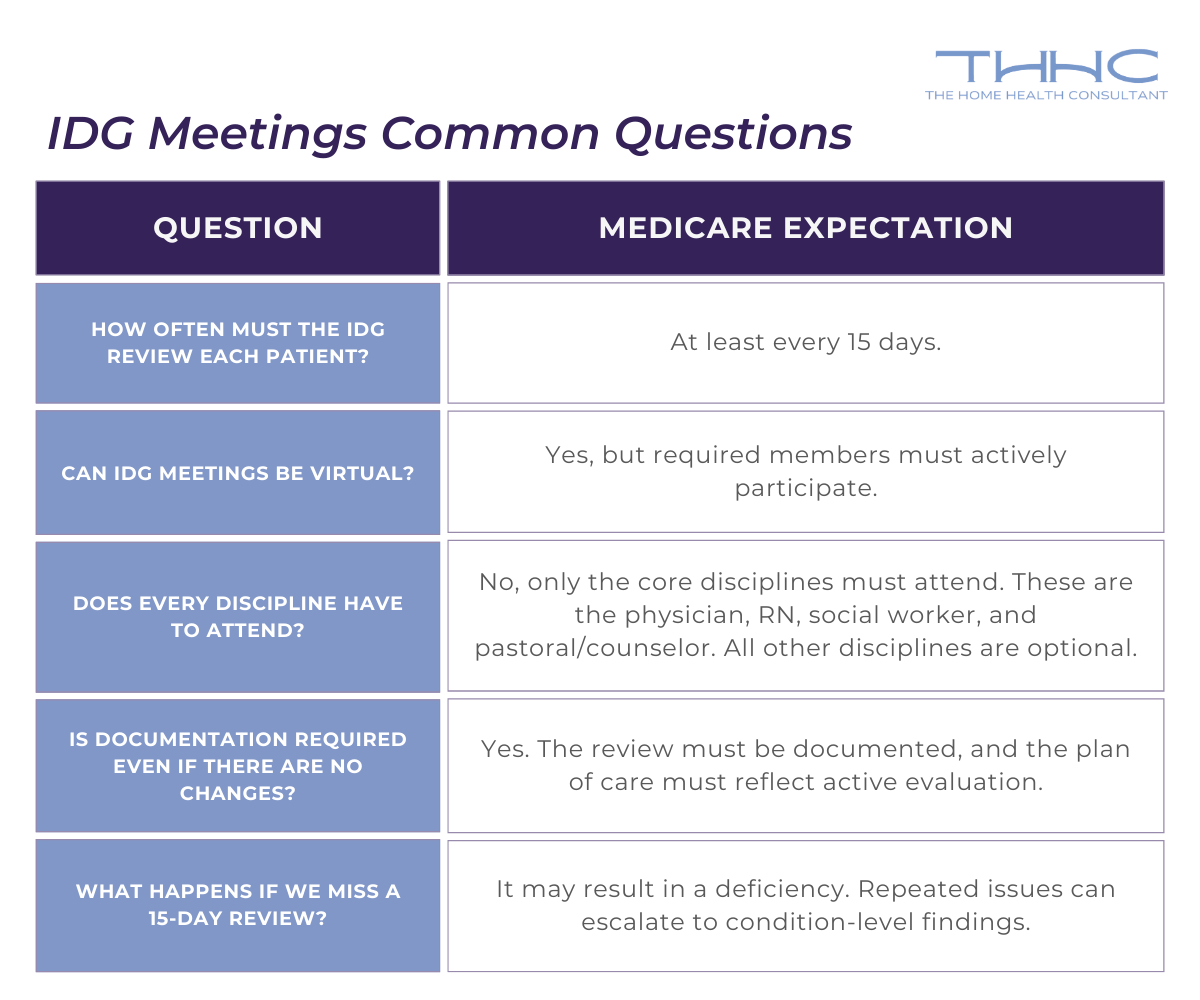
Medicare requires that the IDG review each patient’s plan of care at least every 15 days. That timeline is not discretionary. It is a regulatory expectation tied directly to compliance.
During each review, the IDG must evaluate:
- The patient’s current condition
- Whether services remain appropriate
- Whether interventions need adjustment
- Whether visit frequencies require revision
If a patient experiences a significant change in condition before the next scheduled review, the plan of care must be updated sooner. Waiting for the next 15-day meeting is not compliant when needs change.
Surveyors frequently compare IDG review dates to clinical documentation. When the 15-day requirement is missed, even by a small margin, it becomes a cited deficiency.
Who Is Required to Participate in the Hospice IDG Meeting?

IDG meetings are not optional team huddles. They’re a part of the formal regulatory structure through which hospice care is authorized and coordinated. Because of this, a few key members of your hospice team must be in attendance.
The required core members of the IDG include:
- A physician (employee or contracted)
- A registered nurse
- A social worker
- A pastoral or other counselor
Here’s an example of the roles each discipline plays in a hospice IDG meeting:
- The physician member plays a key role in reviewing the medical components of the patient’s condition and directing the plan of care.
- The registered nurse provides clinical updates, symptom management insight and serves as the main coordinator of the IDG.
- The social worker addresses psychosocial concerns and support systems.
- The pastoral or spiritual counselor contributes to spiritual care planning.
Again, these disciplines are required by Medicare to actively participate in developing and updating the plan of care. Attendance may occur in person or through telecommunication, but the participation must be meaningful.
Additional team members (including but not limited to hospice aides or therapists) may contribute, but they do not replace the required members.
Now that you know who needs to participate, we’ll review what must be documented in a hospice IDG meeting.
What Must Be Documented During an IDG Review?
Medicare expects documentation that demonstrates the IDG actively reviewed and updated the individualized plan of care.
That documentation should reflect:
- The patient’s current status
- Ongoing symptoms and management strategies
- Any medication or intervention adjustments
- Updated goals of care
- Revised visit frequencies, when applicable

Documentation needs reflect interdisciplinary discussion. When IDG notes appear authored by a single discipline without evidence of collaborative review, surveyors may question whether the meeting met regulatory expectations.
Simply stating “IDG reviewed and will continue plan” without patient-specific details may raise concerns. Again, surveyors often compare IDG notes with clinical visit notes to determine whether updates reflect actual changes in condition.
The IDG meeting is not just about meeting. It is about revising the written plan of care in a way that clearly aligns with the patient’s current health status and needs.
Can Hospice IDG Meetings Be Conducted Virtually?
Yes. Medicare permits hospice IDG meeting participation via HIPAA-compliant phone or electronic communication.
However, virtual participation does not reduce regulatory obligations. All required disciplines must still participate, and documentation must reflect interdisciplinary review.
Agencies should ensure that remote attendance is documented clearly and that the collaborative nature of the meeting is evident in the record.
What Are the Most Common Compliance Risks Related to IDG Meetings?

When agencies experience IDG-related deficiencies, they often stem from:
- Missed or late 15-day reviews
- Required disciplines not participating
- Templated documentation without patient-specific detail
- Plans of care not updated to reflect clinical changes
- Lack of physician involvement
Because the IDG is central to hospice operations, weaknesses here often trigger additional findings related to care coordination, documentation, and eligibility oversight.
What Questions Do Hospice Leaders Commonly Ask About IDG Meetings?
Below is a simplified reference chart addressing common operational questions regarding hospice IDG meetings:
How Does the IDG Process Intersect with Other Hospice Compliance Areas?
The IDG does not function independently. It intersects with:
- Initial and comprehensive assessments
- Ongoing eligibility review
- Volunteer and bereavement planning
- Quality assessment and performance improvement (QAPI)
- Coordination of services
When surveyors cite issues related to symptom management or care planning, the root cause often traces back to IDG structure and documentation.
Agencies that treat IDG meetings as structured clinical reviews, rather than informal updates, tend to demonstrate stronger regulatory alignment.
If you are evaluating the strength of your overall leadership structure, we also recommend reading our article on Governing Body Meetings. The governing body and the IDG operate in different regulatory lanes, but weaknesses in one often point to weaknesses in the other.

*Disclaimer: The content provided in this article is not intended to be, nor should it be construed as, legal, financial, or professional advice. No consultant-client relationship is established by engaging with this content. You should seek the advice of a qualified attorney, financial advisor, or other professional regarding any legal or business matters. The consultant assumes no liability for any actions taken based on the information provided.
Topics: