

For many home health and hospice agencies, Medicare Advantage can feel like Medicare with extra rules, lower payments, and more risk. It can also feel like there’s no clear explanation of where the responsibility actually shifts on the provider side.
*This article was written in consultation with Mariam Treystman.
At The Home Health Consultant, we work with Medicare-certified home health and hospice agencies nationwide on compliance, strategy, and survey readiness. We’re writing this article to clearly explain:
- What Medicare Advantage is
- How Medicare Advantage differs from standard Medicare on the provider side
- What agencies should understand before deciding how, or if, to work with these plans
This article is written for providers only. We will not discuss patient decision-making. Instead, we’ll focus on operations, reimbursement, authorization, billing, contracting, and hospice-specific nuances that directly affect agency risk and sustainability.
What Is Medicare Advantage from a Provider Perspective?
Medicare Advantage (also called Medicare Part C) is a Medicare-approved alternative to Original Medicare that is administered by private insurance companies, not CMS (or its MAC’s) directly.
From a provider standpoint, the most important shift is this:
Medicare Advantage replaces CMS as the payer with a private insurer, even though the benefit is still “Medicare.”
That single change affects nearly every operational area for agencies:
- Who authorizes care
- How reimbursement is determined
- Whether networks apply
- How claims are processed
- How denials and appeals are handled
Although Medicare Advantage plans must cover at least the same services as original Medicare, they are allowed to manage how, when, and under what conditions those services are delivered and paid. This is where most agency confusion begins.
How Is Medicare Advantage Different from Original Medicare for Home Health and Hospice Agencies?
The difference between Original Medicare and Medicare Advantage is not theoretical, it’s operational.
Below is a provider-side comparison highlighting where agencies feel the differences impact most.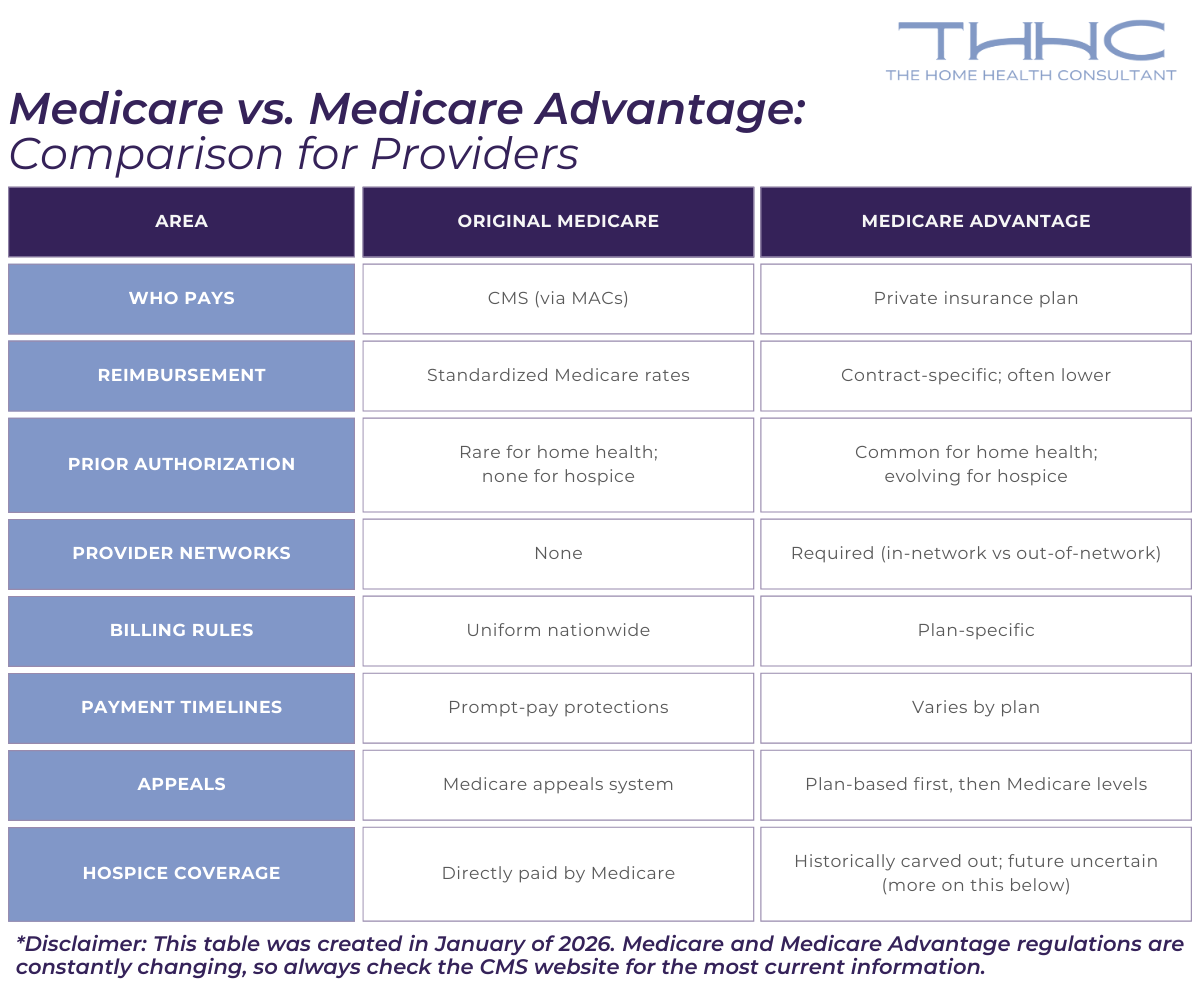
This table alone explains why agencies often say Medicare Advantage “doesn’t feel like Medicare.” Now let’s dive deeper into the details.
How Does Medicare Advantage Reimbursement Affect Agency Financial Risk?

Original Medicare reimbursement is predictable. Agencies know the rates, the case-mix methodology, and the billing timelines.
Medicare Advantage reimbursement is contractual.
Plans often base payment on Medicare rates, but not always at 100%. Many contracts pay a percentage of Medicare or impose alternative payment structures. This creates three potential financial risks:
- Lower margins per case
- Higher administrative cost per episode
- Cash-flow instability due to delayed or denied claims
Understanding the reimbursement terms before working with Medicare Advantage is essential to ensure it’s sustainable for your agency.
Why Do Medicare Advantage Plans Require Prior Authorization for Home Health?
Under Original Medicare, home health services typically begin based on physician orders and documented eligibility. Reviews happen after the fact and selectively, via the ADR process.
Under Medicare Advantage, prior authorization is routine. Most plans require authorization before care starts and again when services extend beyond an initial period.
This impacts agencies by:
- Increasing intake and billing workload
- Creating risk of nonpayment if authorization lapses
- Agencies must be diligent about defending clinical decisions earlier and more frequently
Agencies must track authorization timelines closely. Providing visits outside an approved authorization window is one of the fastest ways to trigger denials.
How Do Medicare Advantage Provider Networks Affect Referrals?
Original Medicare has no provider networks. Any Medicare-certified agency can serve any beneficiary.
Medicare Advantage does have provider networks.
So, when considering how to work with Medicare Advantage, agencies should shift into ‘payer strategy mode.’ Here are a few questions to ask before making a decision:
- Which plans dominate the local market?
- Which plans refer a high volume of patients?
- Which plans are operationally manageable?
- Which plans create excessive financial or compliance risk?
Being in-network increases access but also binds agencies to the plan’s rules. Agencies must balance volume versus sustainability, not just acceptance.
How Does Billing Medicare Advantage Differ from Billing Medicare?
Billing Medicare Advantage is not just “billing Medicare with a different payer name.” Instead, it works similarly to billing private insurance.
Each plan may have:
- Unique claims portals
- Different documentation requirements
- Authorization number requirements
- Varying clean-claim definitions
- Different payment timelines
Unlike Medicare, Medicare Advantage plans are not uniformly bound by federal prompt-pay timelines. Claims may sit unpaid longer, requiring active follow-up.
How Does Medicare Advantage Affect Hospice Agencies Specifically?

Hospice operates differently under Medicare Advantage, and the rules are actively evolving.
Historically, hospice has been carved out of Medicare Advantage. Meaning, when a Medicare Advantage enrollee elects hospice, Original Medicare pays the hospice, not the MA plan.
However, a hospice carve-in was recently tested. This carve in would allow MA plans to cover hospice directly. That demonstration ended in 2024, but legislation has been introduced that could require all Medicare Advantage plans to include hospice in the future.
For now, hospice agencies should monitor policy changes closely to be prepared for any changes.
What Should Agencies Consider Before Working with Medicare Advantage Plans?
Before contracting or expanding Medicare Advantage participation, agencies should evaluate:
- Reimbursement rates versus cost of care
- Authorization and utilization requirements
- Claims and appeal burden
- Payment timelines
- Volume potential
- Compliance risk exposure
Agencies that treat Medicare Advantage as “just another Medicare claim” will struggle. Agencies that approach it intentionally will remain stable.
To approach Medicare Advantage more intentionally, we at The Home Health Consultant recommend ensuring your agency has:
- Stronger payer strategy
- Better billing and authorization controls
- Clear understanding of contract risk
- Ongoing compliance education
Medicare Advantage participation is a strategic and financial decision that affects compliance, staffing, and sustainability.
Should Your Agency Work with Medicare Advantage or Private Insurance?
Medicare Advantage sits at the intersection of Medicare and private insurance, and it raises a bigger question agencies must answer:
Should your agency work with private insurance at all?
We break that decision down in detail in our related article:

*Disclaimer: The content provided in this article is not intended to be, nor should it be construed as, legal, financial, or professional advice. No consultant-client relationship is established by engaging with this content. You should seek the advice of a qualified attorney, financial advisor, or other professional regarding any legal or business matters. The consultant assumes no liability for any actions taken based on the information provided.
Topics:






















.png?width=850&height=400&name=Rando%20(7).png)
