


Who can make medical decisions for a hospice patient when no family is available?
Imagine receiving a referral for a patient who needs hospice services following hospitalization but has advanced dementia and cannot consent to treatment. The patient lives alone, has no family nearby, and has no obvious legal representative.
Or perhaps a patient is no longer able to communicate their wishes, and no family member is available to sign admission documents.
For Medicare-certified hospice agencies in California, situations where a patient cannot consent raise important questions:
- Who can authorize care?
- Can a friend make decisions?
- Does the agency need a court order?
Fortunately, California law provides a process for identifying or selecting someone to make health care decisions when a patient cannot do so independently. And a court order is not always necessary.
*This article was written in consultation with Mariam Treystman.
At The Home Health Consultant, we help agencies navigate situations where patient care, regulatory requirements, and legal responsibilities intersect. After reading this article, we hope you’ll have a better understanding of:
- Who can legally make health care decisions when a patient is unable to consent and has no family available
- What options California law provides
- How your agency can handle these situations while protecting patient rights and maintaining compliance
How Can Hospice Agencies Determine If a Patient Has the Capacity to Consent?
Before looking for someone to make decisions on the patient's behalf, agencies must determine whether the patient actually lacks decision-making capacity.
Under California law, unless a written advance health care directive specifies otherwise, the primary physician determines whether the patient lacks or has recovered capacity to make health care decisions.
A diagnosis of dementia, cognitive impairment, or another medical condition does not automatically mean a patient is incapable of making decisions.
For example, a patient with early-stage dementia may still understand the purpose of hospice services and agree to treatment. Another patient may have fluctuating capacity and be able to make certain decisions but not others.
Agencies should:
- Identify the specific decision requiring consent.
- Obtain the appropriate physician determination when capacity is in question.
- Document the findings in the clinical record.
- Reassess when the patient's condition changes.
Importantly, being unable to physically sign a form is not the same as lacking decision-making capacity. A patient who understands and agrees to care but cannot write may require an alternative way to document consent, not a substitute decision-maker.
Who Can Legally Make Medical Decisions for a Hospice Patient Who Cannot Consent in California?
If the patient lacks capacity, the next step is determining whether someone already has legal authority to act on their behalf.
Under California law, the following decision-makers are recognized in descending order of priority:
- Patient-designated surrogate: Someone the patient personally selected.
- Health care agent: Someone appointed through an advance health care directive or health care power of attorney.
- Conservator or guardian: Someone with court-granted authority to make health care decisions.
Agencies should review available advance directives, hospital records, and court documents before accepting another person's consent.
An emergency contact, caregiver, or family member is not automatically an authorized representative.
Can a Patient Verbally Appoint Someone to Make Medical Decisions in California?
Yes, a patient may personally inform the supervising health care provider or an appropriate facility designee that they want a particular adult to serve as their surrogate.
The designation must be recorded in the patient's health record.
Unless a shorter period is specified, the designation generally remains effective for the current course of treatment, illness, or institutional stay, or 60 days, whichever is shorter.
This can be particularly helpful when a patient has no family but trusts a friend or another individual to make decisions if needed.
However, the patient must have sufficient capacity to make the designation. The agency cannot create a patient-designated surrogate after the patient has lost that ability.
Who Can Consent to Medical Treatment If a Patient Has No Family or Legal Representative?

This is where California's surrogate selection law becomes especially important.
When a patient lacks decision-making capacity and has no legally recognized decision-maker, a health care provider or a designee of the health care facility caring for the patient may select a surrogate.
The person selected does not necessarily have to be related to the patient.
The surrogate must be an adult who:
- Has demonstrated special care and concern for the patient.
- Is familiar with the patient's personal values and beliefs, to the extent known.
- Is reasonably available and willing to serve.
Potential surrogates include a spouse or domestic partner, adult child, parent, sibling, grandchild, another adult relative, or a close personal friend.
California law does not establish an automatic family ranking for this selection process.
Can a Friend Make Medical Decisions for a Patient in California?
Yes, potentially.
Consider a hospice patient with advanced dementia whose spouse has died and whose children cannot be located.
The patient has a longtime friend who regularly visits, helps coordinate medical appointments, and understands the patient's end-of-life preferences.
That friend may be an appropriate candidate for surrogate selection. However, agencies should not simply ask the friend to sign consent documents.
Agencies must first establish:
- the surrogate was appropriately selected
- the surrogate meets the statutory criteria
- the surrogate has authority to make the decisions involved
An important distinction: Not every hospice employee automatically has authority to select a surrogate. Agencies should confirm who qualifies as an authorized selector under California law and ensure their procedures reflect those requirements.
What Medical Decisions Can a Health Care Surrogate Make in California?
A properly authorized surrogate may make health care decisions within the scope of their authority.
Depending on the circumstances, these decisions may involve:
- Consenting to recommended medical treatment.
- Discussing medications and treatment options.
- Participating in the patient's plan of care.
- Making decisions about medical interventions.
- Addressing end-of-life treatment preferences.
However, a surrogate cannot simply make decisions based on personal preference.
Under California law, the surrogate must follow the patient's individual health care instructions and known wishes.
When those wishes are unknown, the surrogate must act in the patient's best interests while considering the patient's values and beliefs.
Surrogate authority to make medical decisions also does not automatically include control over the patient's finances, property, or unrelated legal matters.
For hospice agencies, an additional consideration is whether the surrogate's state-law authority satisfies the federal requirements for executing a Medicare hospice election. Always check your state's laws regarding surrogate decision-making, consent to treatment, and who is legally authorized to sign hospice election documents, as requirements may vary by state.
What Documentation Is Required When Selecting a Health Care Surrogate in California?
Even when an appropriate surrogate has been identified, documentation is essential.
Agencies should maintain a clear record showing how the decision-making authority was established.
We recommend documenting:
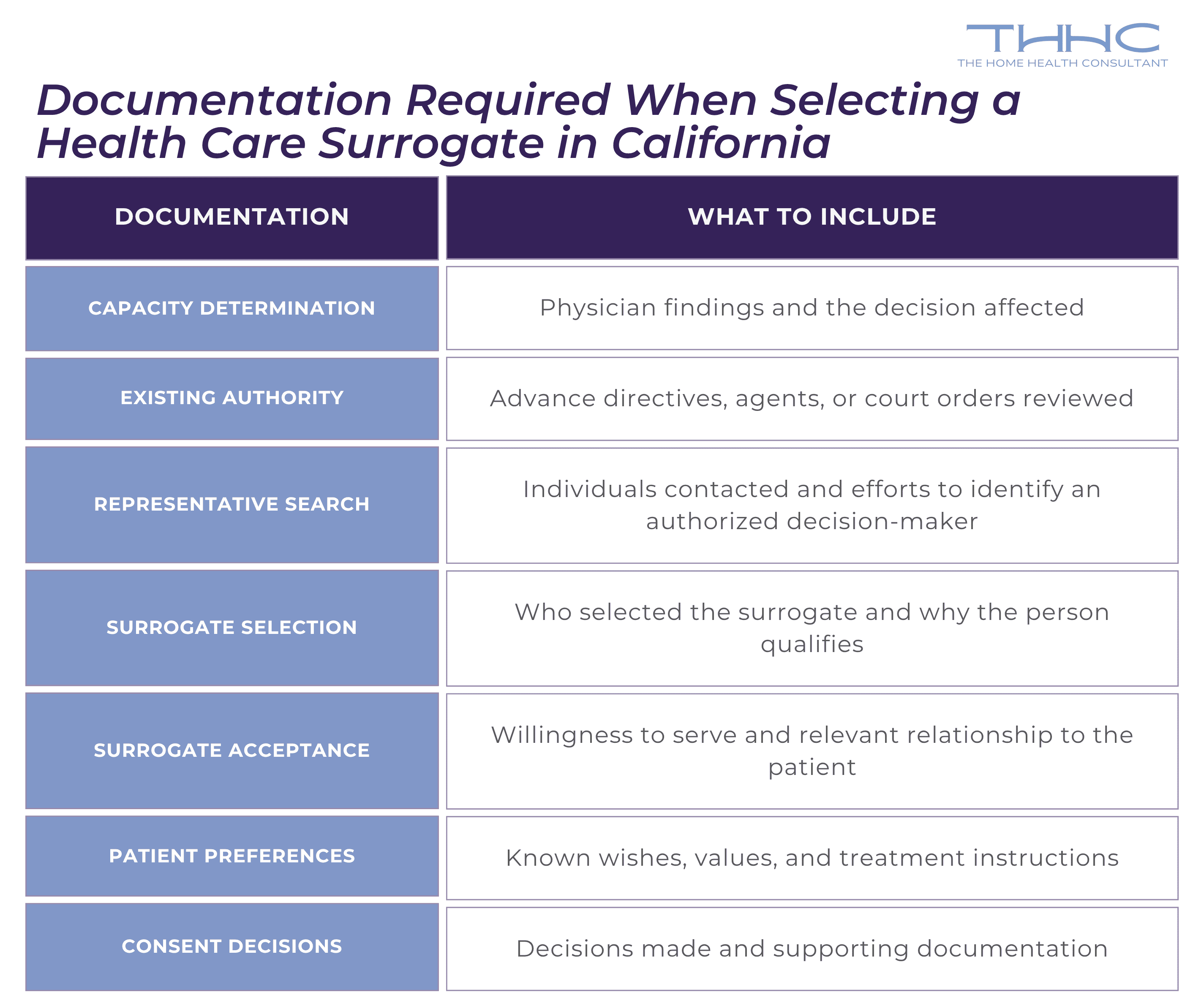
Important Note: These are recommended documentation practices intended to support compliance and demonstrate that the agency followed an appropriate process. They are not a specific documentation checklist required by California law or Medicare regulations. Agencies should ensure their procedures align with applicable state and federal requirements, their internal policies, and the circumstances of each patient.
What Happens When an Incapacitated Patient Has No One to Make Medical Decisions?
Sometimes a patient has no family, no close friends, no advance directive, and no other individual who qualifies to serve as a surrogate.
In this situation, agencies should not assume they can appoint an employee or unrelated person to make decisions.
Instead, they should coordinate with the patient's physician, appropriate social services resources, and California legal counsel to evaluate available options.
Depending on the circumstances, the solution may involve a court petition for a particular health care decision or a conservatorship when broader, ongoing assistance is necessary.
The key is that having no family does not automatically require court intervention—but having no legally authorized decision-maker may make court involvement necessary.
How Can Hospice Agencies Handle Consent Issues Before Admission?

These situations are easier to address when agencies identify potential consent problems before admission.
Referral and intake staff should determine whether the patient has:
- an advance directive,
- a health care agent,
- a conservator,
- or a trusted individual involved in medical decisions.
If the referral indicates cognitive impairment or an inability to communicate, the agency should request relevant documentation and coordinate with the referring provider before the admission visit whenever possible.
Agencies should also ensure their policies explain when to escalate concerns about consent and who is responsible for reviewing surrogate authority.
What Should Agencies Remember About Patient Rights?
Understanding who can make health care decisions is just one part of protecting patient rights. Medicare-certified home health and hospice agencies must also ensure patients are informed, involved in their care, and treated according to their rights under the Conditions of Participation.
Want to make sure your agency is meeting these requirements? Read our related article on Patient Rights in Hospice to learn more about your agency's responsibilities and how to avoid common compliance issues.

*Disclaimer: The content provided in this article is not intended to be, nor should it be construed as, legal, financial, or professional advice. No consultant-client relationship is established by engaging with this content. You should seek the advice of a qualified attorney, financial advisor, or other professional regarding any legal or business matters. The consultant assumes no liability for any actions taken based on the information provided.
Topics: