


An Additional Documentation Request, or ADR, can create significant stress for a home health or hospice agency. By the time the request arrives, the patient may already be discharged, clinicians involved in the case may no longer work for the agency, and the team suddenly has a limited amount of time to assemble documentation that supports a claim submitted months earlier.
But agencies do not have to wait for an ADR to start looking for risk.
*This article was written in consultation with Mariam Treystman.
In our recent webinar, The Home Health Consultant Co-Founder Mariam Treystman explained how home health and hospice agencies can use Medicare data to identify potential vulnerabilities before a contractor requests the chart.
Want to listen to this article instead? Watch the accompanying podcast below!
Check out our channel & subscribe for a new podcast episode every week.
As Mariam explained:
“Your job is to find your outliers before a contractor does.”
The goal is not to manipulate your data so your agency looks average. It is to understand where your agency is statistically unusual, confirm that the billing and coding are accurate, and make sure the clinical record supports the story being reported to Medicare.
What Is a Medicare ADR?
An ADR is an Additional Documentation Request asking a provider to submit records supporting a billed Medicare claim.
ADRs may be triggered in several ways, including:
- Random sampling
- Unusual billing patterns
- Targeted prepayment or post-payment edits
- Scheduled or focused medical reviews
Important Note: Agencies cannot prevent every ADR. Random reviews, for example, may occur regardless of how strong the agency's compliance program is.
The opportunity lies in identifying and addressing the kinds of billing anomalies and payment-risk patterns that may draw additional scrutiny.
Medicare Administrative Contractors (MACs), Recovery Audit Contractors (RACs), Unified Program Integrity Contractors (UPICs), and Supplemental Medical Review Contractors (SMRCs) may all play roles in Medicare claim review.
Medicare Is Giving Agencies More Data Than Ever Before
CMS has access to an enormous amount of claims, utilization, quality, and assessment data.
As Mariam shared in the webinar, agencies need to start treating the reports CMS provides as compliance tools rather than documents that are downloaded and forgotten.
We may not know the exact algorithm Medicare uses to select every claim for review. But agencies can see many of the same risk signals Medicare is monitoring.
The Home Health Consultant organizes those signals into three practical layers:
- Direct payment-risk: What does our billing look like to Medicare?
- Quality and utilization: Does the clinical and utilization story support those billing patterns?
- Active government-review: What issues are Medicare contractors and federal oversight agencies examining right now?
These are not official CMS categories. They are a framework agencies can use to make sense of information that otherwise exists across numerous reports and government sources.
Start With PEPPER: Find Your Billing Outliers
For both home health and hospice agencies, one of the most important starting points is the Program for Evaluating Payment Patterns Electronic Report, or PEPPER.
PEPPER compares an agency's claims and utilization patterns with those of its peers and identifies statistical outliers associated with potential improper-payment risk.
An outlier does not mean the agency billed incorrectly.
It means the agency's pattern falls outside the norm compared with other providers.
Mariam explained:
“When we find outliers, we want to make sure that they are accurately coded and supported by clinical documentation. This is the main point here.”
PEPPER therefore gives agencies a starting point for internal review.
Home Health PEPPER Risk Areas
Home health PEPPER measures discussed in the webinar include areas such as:
- Low and high comorbidity
- Medium and high functional impairment
- Average case mix
- Average number of periods
- Periods with low visits
- Non-LUPA payments
- Outlier payments
- Admission source
If an agency is an outlier in one of these areas, leadership should identify the claims contributing to that pattern and determine whether the coding, utilization, and clinical documentation support it.
Hospice PEPPER Risk Areas
For hospice agencies, the report may highlight patterns involving:
- Live discharges where the patient is no longer terminally ill
- Revocations
- Live discharges after 61–179 days
- Lengths of stay of 180 days or longer
- Routine home care in assisted living, nursing facilities, and skilled nursing facilities
- Claims with only one diagnosis
- Lack of GIP or continuous home care
- Long GIP stays
- Medicare Part B or Part D utilization involving hospice beneficiaries
Again, being an outlier is not proof of wrongdoing. PEPPER is intended to identify areas worth reviewing, not automatically identify improper payments.
Next, Ask Whether the Clinical Story Supports the Billing Story

PEPPER shows where the agency may look unusual financially or statistically.
The next question is:
Does the clinical and utilization data make sense alongside those billing patterns?
For home health agencies, useful data sources include:
- Home Health Value-Based Purchasing reports
- OASIS and Quality Reporting Program data
- Outcome-Based Quality Improvement and Outcome-Based Quality Monitoring reports
- Care Compare
For hospice agencies, useful sources include:
- Hospice Quality Reporting Program data
- Hospice Care Index
- Hospice Visits in the Last Days of Life
- HOPE assessment data
- Care Compare
These reports are not necessarily published as direct ADR-selection tools. Instead, they help an agency determine whether the clinical outcomes, utilization patterns, and documentation story corroborate what appears in claims data.
For example, suppose a home health agency's PEPPER data shows patients receiving significantly more periods of care than its peers.
The agency could identify the patients contributing to that outlier and then review quality and outcome data for those same cases.
- Are patients showing improvement?
- Do the functional scores support continued skilled care?
- Does the documentation explain why longer episodes were medically necessary?
That is where the reports become much more useful when reviewed together rather than independently.
Know What Medicare Contractors Are Reviewing Right Now
The third layer is active government-review.
Medicare contractors and federal agencies regularly publish information about the areas they are examining.
Sources include but are not limited to:
- MAC Targeted Probe and Educate and medical-review topics
- RAC-approved review topics
- SMRC review projects
- CERT findings
- CMS provider compliance tips
- HHS OIG Work Plan
- HHS OIG audit reports
- DOJ healthcare fraud and False Claims Act cases
- CMS review contractor information
Together, these sources can help agencies answer a very important question:
Are our statistical outliers occurring in areas the government is actively reviewing?
The more those signals overlap, the stronger the reason to perform a focused internal audit.
Current High-Risk Areas for Home Health Agencies
For home health agencies, the webinar highlighted several recurring areas of review risk.
Skilled Need, Medical Necessity and Homebound Status
The clinical record must establish why skilled services are necessary and why the patient meets Medicare's homebound requirements.
Documentation should tell the patient's actual clinical story rather than simply repeat standardized eligibility language.
PDGM Coding and OASIS Support
The diagnoses, comorbidities, functional level, and other information affecting PDGM payment must be supported throughout the record.
As Mariam explained, agencies can submit information through OASIS and claims systems, but if the nursing notes, therapy documentation, and clinical narratives do not support that information, an ADR may result in denial.
Certification, Face-to-Face and Plan of Care
Agencies should also be prepared to support initial Medicare eligibility, even when an ADR involves a later episode.
The initial face-to-face encounter, certification, homebound status, and medical necessity may still be relevant to the review.
Long-Term Recertification and Visit Patterns
Repeated recertifications naturally create additional scrutiny.
LUPA-related patterns can also be important. If an agency repeatedly provides visits just above the LUPA threshold, that pattern may warrant internal review.
Current High-Risk Areas for Hospice Agencies
For hospice providers, the biggest concern remains terminal eligibility.
Agencies should pay particular attention to:
- Certification and recertification
- Physician narratives
- Long lengths of stay
- Live discharges
- Revocations
- New admissions with questionable eligibility
- GIP, continuous home care, and respite utilization
- Nursing facility utilization
- Medicare spending outside of the hospice benefit
Non-hospice Medicare spending deserves particular attention because CMS and the OIG have examined situations where services, medications, supplies, or hospital care were billed outside of hospice even though the hospice may have been responsible for them.
Build an ADR Early-Warning System
The most useful takeaway from the webinar is not simply that agencies should review more reports.
It is that the reports should be connected.
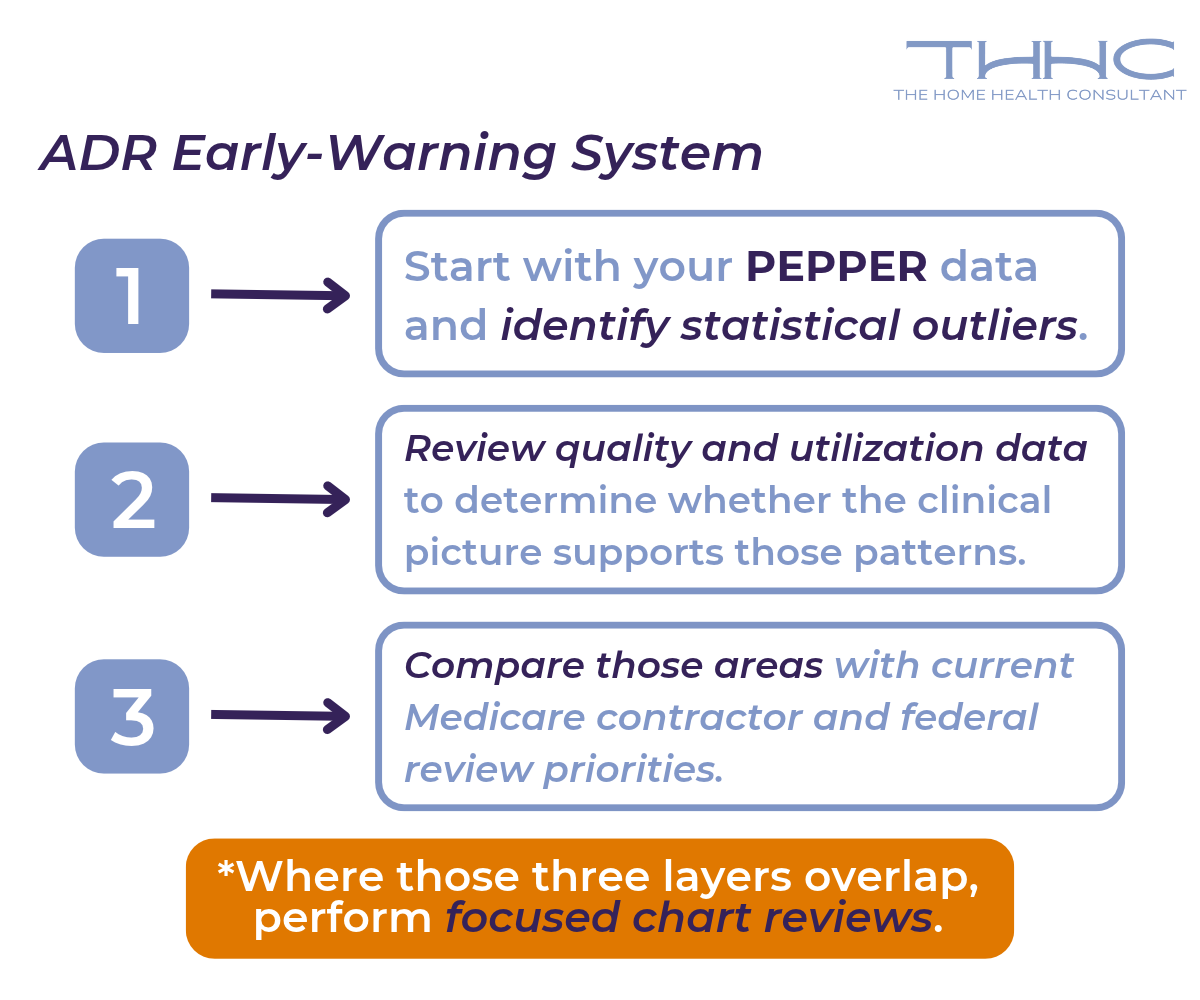
Mariam describes this as a three-layer early-warning system for ADR risk:
Unusual billing → Clinical and utilization support → Current government review priorities
Agencies can use this process not only to review historical claims, but also to identify higher-risk patients while they are still receiving care.
Your DPCS, clinical leadership, QA staff, or compliance team should be asking throughout the episode whether the patient falls into a known outlier category, whether documentation supports the coding, and whether Medicare is actively reviewing that type of claim.
Be Prepared Before the ADR Arrives

Even a strong compliance process cannot eliminate ADRs entirely. That is another reason agencies should identify higher-risk cases before a request arrives.
Once an ADR is received, Mariam notes that the agency may have approximately 30 or 45 days, depending on where the request comes from, to submit the requested documentation. By that point, the patient may already be discharged and the clinicians involved in the case may no longer be available.
Agencies should therefore make sure higher-risk charts are complete and defensible while the patient is still receiving services.
Mariam also cautions agencies reviewing a later episode not to overlook the beginning of the case. If an ADR involves, for example, a third home health episode, the agency may still need to establish the patient's initial Medicare eligibility, including the original face-to-face encounter, certification, homebound status, and medical necessity.
Preparing the record correctly from the beginning makes responding to an ADR much easier than trying to reconstruct the clinical story after the request arrives.
Do Not Try to Make Your Numbers Look Average
One final caution: the goal is not to change legitimate coding or care simply to move an agency's PEPPER percentile into the “normal” range.
A patient may appropriately require longer care, higher utilization, greater comorbidity coding, or services that cause the agency to appear statistically unusual.
The compliance question is whether those patterns are accurate and defensible.
Your data should lead you to the charts that deserve attention.
Then the clinical record should tell the rest of the story.
The best time to find that vulnerability is while the patient is still on service—not after an ADR arrives and the agency has to reconstruct the case months later.
The Home Health Consultant’s Administrative Compliance Program helps home health and hospice agencies stay ahead of these issues throughout the year. Our team works with agency leadership to review compliance data, identify potential vulnerabilities, strengthen documentation, and prepare for the types of issues that can lead to ADRs, denials, and survey deficiencies.
Learn more about our Administrative Compliance Program and how we can help your agency stay survey-ready and reimbursement-ready year-round.

*Disclaimer: The content provided in this article is not intended to be, nor should it be construed as, legal, financial, or professional advice. No consultant-client relationship is established by engaging with this content. You should seek the advice of a qualified attorney, financial advisor, or other professional regarding any legal or business matters. The consultant assumes no liability for any actions taken based on the information provided.
Topics: