

Choosing a compliance partner is not a low-risk decision.
For many agency owners and administrators, you realize your agency needs more support at a point of pressure. This could be:
- After a difficult survey
- During rapid growth
- When internal staff can no longer keep up with administrative requirements
The challenge isn’t finding a compliance service. It’s knowing whether the one you choose will actually provide the level of structure, oversight, and follow-through your agency needs.
Too often, agencies commit to support that looks comprehensive at the start, but over time feels reactive, unclear, or overly dependent on internal staff to make it work. Documents exist, meetings happen, and fees are paid, but confidence in survey readiness doesn’t feel like it’s improving. That uncertainty is costly, not just financially, but operationally.
*This article was written in consultation with Mariam Treystman.
At The Home Health Consultant (THHC), we work with Medicare-certified home health and hospice agencies that are trying to avoid that outcome. We’re writing this article to explain what structurally makes our Administrative Compliance Program different, so agencies can better evaluate whether this approach aligns with their expectations, risk tolerance, and long-term compliance strategy.
That difference is grounded in three principles that guide how our program is built and managed: Real Data. Real Time. Real Easy. Let’s break down what each of these principles means for your agency.
How Do “Real Data,” “Real Time,” and “Real Easy” Function Inside a Compliance Program?
Before breaking down each principle individually, it helps to understand how they operate together in day-to-day compliance management.
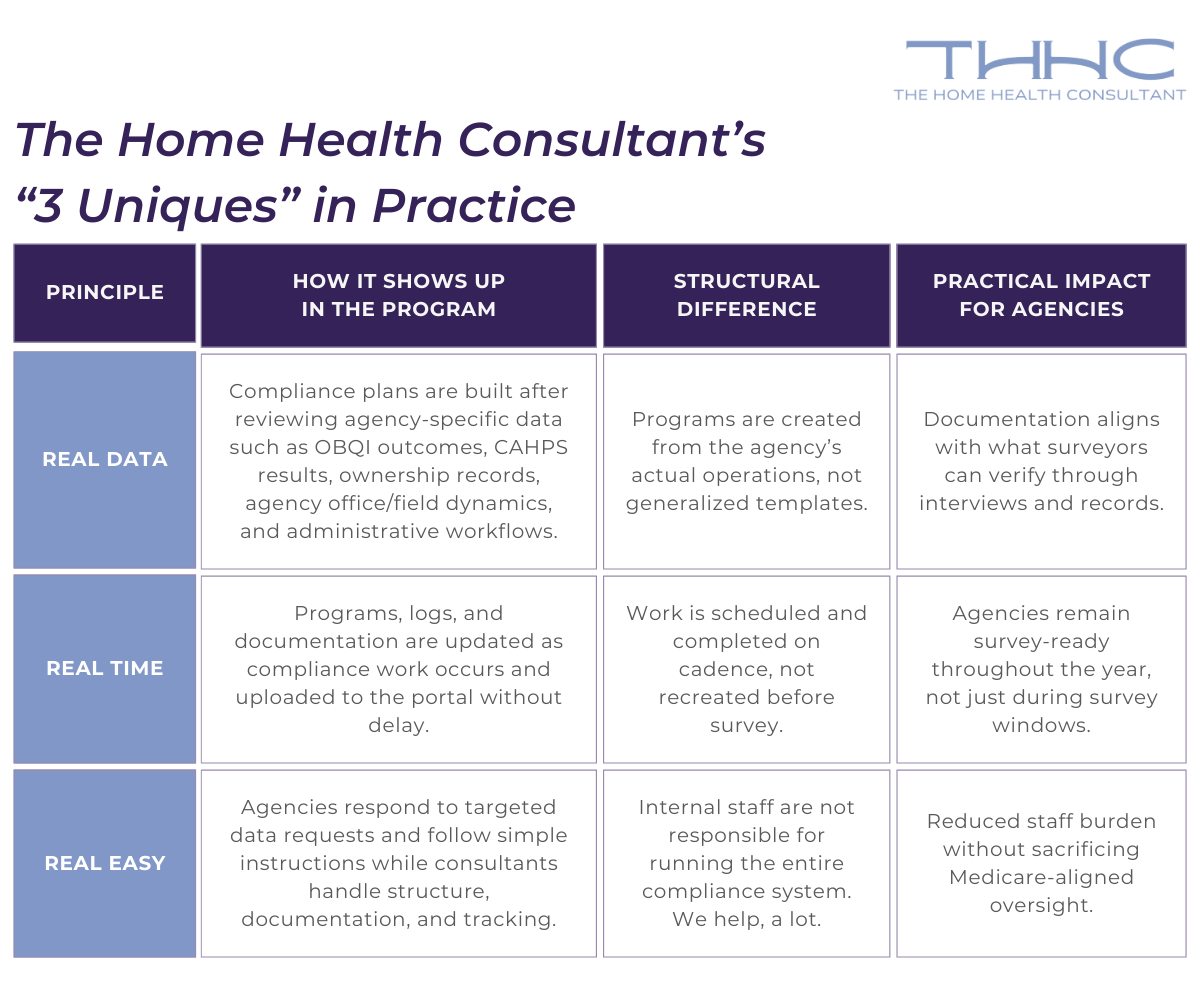
Each principle reinforces the others. When one is missing, compliance becomes reactive, fragile, or overly dependent on internal staff capacity.
What Does “Real Data” Mean in an Administrative Compliance Program?
“Real Data” means compliance programs are built using your agency’s actual administrative, operational and quality information. We don’t rely on assumptions about how the agency should be operating.
Within THHC’s Administrative Compliance Program, compliance planning begins with structured data collection. This includes but is not limited to reviewing agency ownership and corporate records, NPI and enrollment information, OBQI and CAHPS performance, office and field dynamics, patient case mix, and other administrative elements that surveyors routinely validate.
This matters because survey deficiencies often occur when documentation exists but does not accurately reflect operational reality.
Why Does Data-Driven Compliance Matter During Surveys?
Surveyors don’t just check whether documents exist. They evaluate whether:
- QAPI initiatives align with the agency’s actual performance issues
- Governing body oversight reflects real decision-making
- Policies, logs, and meeting records are consistent with staff interviews
When compliance programs are built from real data, agencies are better positioned to explain why programs exist and how they are used.
How is “Real Data” maintained over time?

Data reviews do not stop after onboarding. As part of ongoing monthly and quarterly management, agency data is revisited and used to inform:
- quarterly QAPI topics
- performance improvement projects (PIPs)
- annual compliance reviews tied to Medicare Conditions of Participation
This ensures compliance programs evolve alongside the agency, rather than becoming static documents that slowly lose relevance or fall out of compliance.
What Does “Real Time” Mean for Survey Readiness?
“Real Time” means compliance work is completed and documented when it actually happens, not reconstructed later to fill gaps.
THHC’s program is intentionally structured around monthly, quarterly, and annual cycles so compliance activities are completed on schedule. Updated materials are made available through the portal as work is completed, allowing agencies to access current documentation at any point.
Why is real-time documentation critical?
Backdated or rushed documentation creates risk. Surveyors are trained to look for:
- inconsistencies in timelines
- meeting records that appear recreated
- logs that don’t align with actual workflows
Real Time compliance reduces this risk by ensuring documentation reflects real activity and current Medicare regulations.
How does Real Time support ongoing readiness?
When compliance work is completed continuously, agencies are not scrambling to prepare documentation when surveys are announced (or unannounced). Instead, survey readiness becomes a byproduct of consistent compliance management rather than a separate, rushed, last-minute project.
How Does “Real Easy” Change the Role of Agency Staff?
“Real Easy” means compliance does not consume internal resources unnecessarily.
Many compliance consultants and systems rely on your agency staff to:
- Interpret regulations
- Build programs
- Track compliance
- Prepare documentation
But at THHC, we do things a little differently. THHC limits internal involvement to targeted data collection and collaboration points. Consultants handle the structure, tracking, and organization and maintenance of documentation. This saves you and your staff an immense amount of time. You become the Editor in Chief of your compliance program by:
- Providing relevant information
- Brainstorming your compliance priorities
- Providing feedback on programs to ensure they are perfect for your company
And you don’t have to just take our word for it. In a survey sent out to all of our Administrative Compliance Program members, agencies reported spending just 4–6 hours per quarter on administrative compliance maintenance.
Why is reducing staff involvement important?
Administrative compliance often competes with staffing, patient care coordination, and operational priorities. When compliance systems rely heavily on internal staff, they are vulnerable to:
- turnover
- competing priorities
- burnout
- loss of institutional knowledge
By reducing internal workload, ‘Real Easy’ helps compliance systems remain stable even when staffing changes occur or the company undergoes a volatile period.
How Do These Principles Prevent Common Compliance Breakdowns?

When compliance programs are built using Real Data, maintained in Real Time, and designed to be Real Easy, agencies are less likely to experience:
- documentation that doesn’t match operations or Medicare regulations
- stressful last-minute survey preparation
- compliance gaps during leadership or staff transitions
Instead, compliance becomes a repeatable system that supports long-term Medicare participation.
How Should an Agency Decide If This Compliance Model Is the Right Fit?
The most important decision isn’t which compliance company makes the strongest claims. It’s whether the structure of the program aligns with how your agency operates and how much internal responsibility leadership wants to carry.
Agencies that tend to be a strong fit for THHC’s model see the value in:
- defensible documentation grounded in real operations
- proactive guidance rather than reactive fixes
- reduced internal administrative burden
- a system that continues functioning regardless of staff changes
Understanding how compliance is structured is often the clearest way to evaluate fit.
Want to See How This Compliance System Works Step by Step?
If you’d like a clearer picture of how Real Data, Real Time, and Real Easy are applied throughout the year, we recommend reading our article on our proven administrative compliance process. It outlines how compliance is built, reviewed, and maintained on a monthly, quarterly, and annual basis—so agencies know exactly what to expect.

Need help preventing deficiencies?
Understanding the structure behind compliance support can make the difference between scrambling for surveys and staying consistently prepared. If you’re ready to see how our program can help your agency, feel free to schedule a call with us for a free consultation.

*Disclaimer: The content provided in this article is not intended to be, nor should it be construed as, legal, financial, or professional advice. No consultant-client relationship is established by engaging with this content. You should seek the advice of a qualified attorney, financial advisor, or other professional regarding any legal or business matters. The consultant assumes no liability for any actions taken based on the information provided.
Topics:













.png?width=850&height=400&name=COST%20(2).png)