
Your team finally feels comfortable with OASIS-E1. Your clinicians understand the workflow. Your QA process is in place. Your documentation is consistent.
But now, CMS is introducing another update. This time it is OASIS-E2, and the effective date does not align with the start of the year.
*This article was written in consultation with Mariam Treystman.
At The Home Health Consultant, we work directly with Medicare-certified home health agencies to build compliance systems that hold up during surveys. We are writing this article to help you understand:
- What OASIS-E2 is
- What changed from OASIS-E1
- How to position your agency for success and maintaining compliance
Whether you are refining your current process or building one from scratch, this guide will help you determine what your agency needs next in your compliance journey.
When Does OASIS-E2 Go Into Effect?
OASIS-E2 officially goes into effect on April 1, 2026.
This is important because it is an off-cycle update. It does not follow the typical January 1 implementation timeline that many agencies expect.
At this point, your agency is already operating under the all-payor OASIS requirement, which became mandatory on July 1, 2025.
That means OASIS is already part of your workflow across your entire patient population, not just Medicare.
This context matters when thinking about OASIS-E2.
The changes in OASIS-E2 are relatively targeted. However, they are being applied across a process your team is already performing at a much higher volume than in the past. Even small updates, such as new required elements at Resumption of Care or revised data items, now affect a larger number of assessments across your census.
That is where agencies start to feel the impact. It is not the size of the change. It is how often your team has to apply it.
If you want a quick refresher on how the all-payor requirement expanded OASIS expectations across your agency, we break that down here:
Understanding that foundation helps put the OASIS-E2 changes into the right operational context.
What Is OASIS-E2 in Home Health Care?
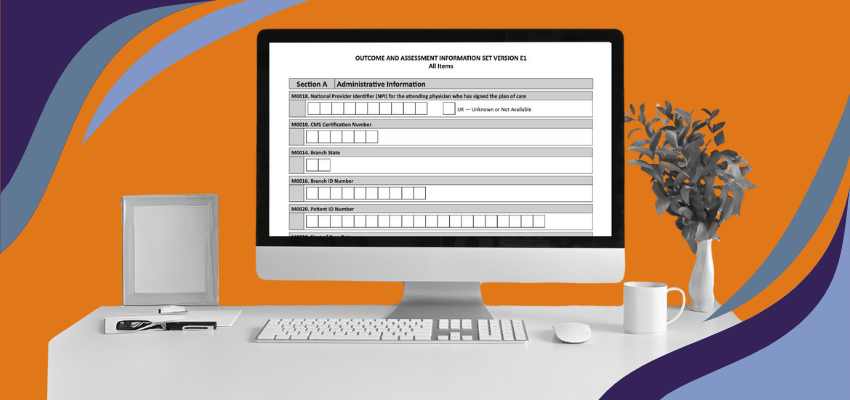
OASIS stands for the Outcome and Assessment Information Set. It is a standardized data collection tool required by CMS, which stands for the Centers for Medicare and Medicaid Services.
OASIS is used to:
- Measure patient outcomes
- Calculate quality scores such as Star Ratings
- Support Medicare payment systems
- Drive programs like HHVBP, which stands for Home Health Value-Based Purchasing
OASIS-E2 is the next version of this tool. It builds on OASIS-E1 to improve data standardization and reduce unnecessary reporting burden.
OASIS is not just documentation. It directly impacts how your agency is evaluated, reimbursed, and publicly reported.
How Is OASIS-E2 Different From OASIS-E1?
OASIS-E2 is not a complete overhaul. The changes are targeted. However, they are high impact if missed.
It is best to think of this as a precision update. But that doesn’t mean it’s not important to know what’s coming. Small changes can create major compliance issues when they are overlooked.
What Specific Items Were Removed, Replaced, or Added?
Here is a clear breakdown of the changes:
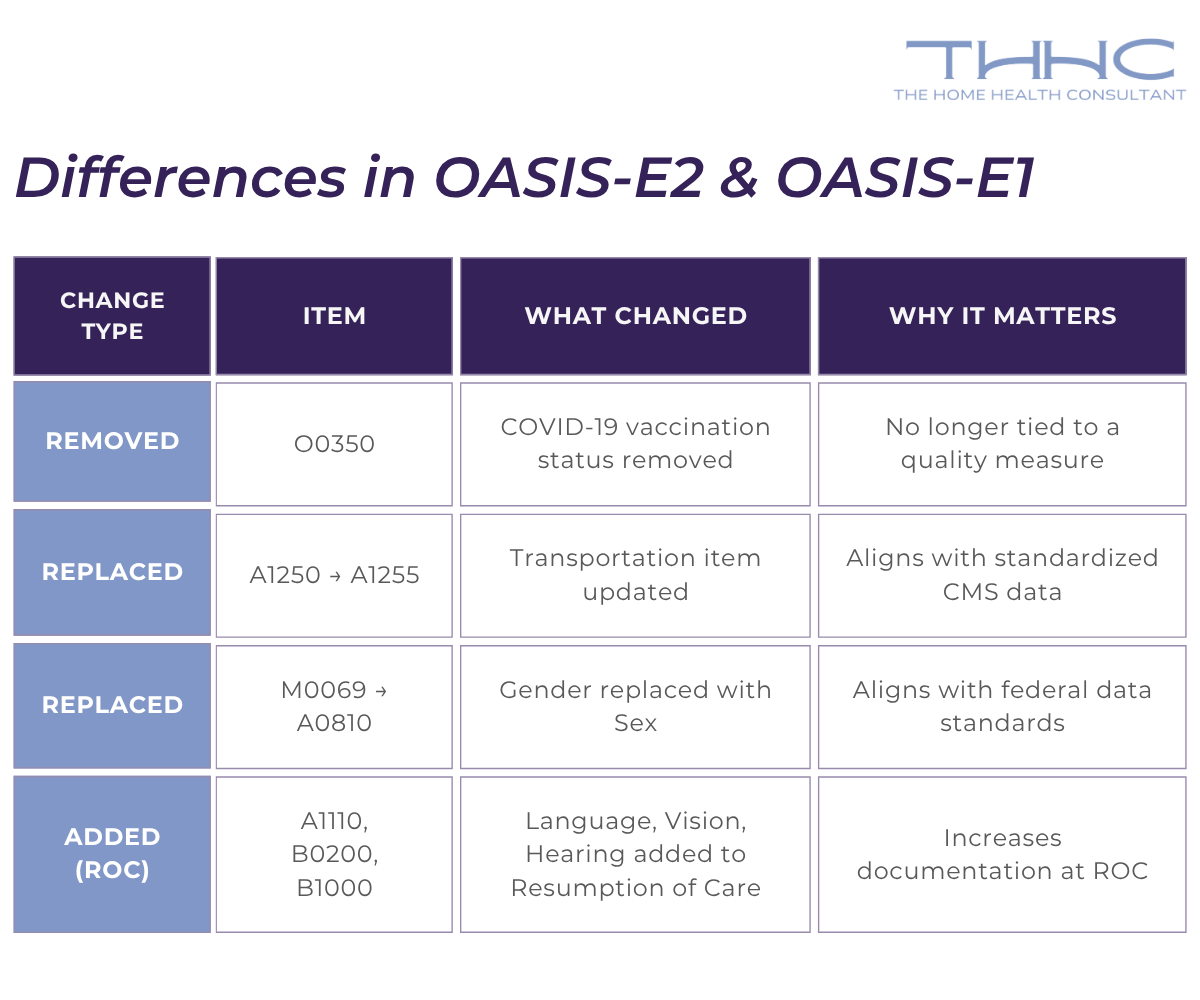 (Source: CMS OASIS-E2 Manual)
Why Do These Changes Matter More Than They Seem?
At first glance, these changes may appear minor.
However, issues arise when:
- A clinician wastes time documenting a removed item
- A Resumption of Care assessment is missing new required elements
- Intake teams continue using outdated terminology
These situations can lead to survey deficiencies, data inaccuracies, or quality reporting issues. All of which can affect your agency's reputation and bottom line.
What Is Resumption of Care and Why Does It Matter More Now?
Resumption of Care, often referred to as ROC, occurs when a patient returns home after an inpatient stay such as a hospital or skilled nursing facility.
OASIS requires a new assessment at this point. This must typically be completed within 2 calendar days of discharge or return home.
With OASIS-E2, ROC becomes more complex because new items have been added:
- Language
- Vision
- Hearing
This increases both the clinical workload and the risk of missed documentation.
Does OASIS-E2 Change Who Needs OASIS Completed?
The rules regarding which patients need an OASIS completed did not change with OASIS-E2. However, expectations have expanded.
Like we mentioned above, as of July 1, 2025, agencies must complete OASIS for:
- Any payor source
- Any patient receiving skilled services
- Any patient who is not exempt
*What are skilled services?
Skilled services are services that require a licensed clinician. Examples include:
- Skilled nursing care
- Physical therapy
- Occupational therapy
- Speech therapy
If your agency provides these services, OASIS likely applies regardless of payor.
How Does OASIS-E2 Impact Quality Scores and Star Ratings?

OASIS data feeds directly into:
- Star Ratings, which are publicly reported
- The Home Health Quality Reporting Program (HHQRP)
- The Home Health Value-Based Purchasing Program (HHVBP)
Even small inconsistencies can affect:
- Outcome measures
- Risk adjustment
- Public reporting
This is why CMS continues refining OASIS. The goal is to ensure consistency and accuracy across agencies.
What Should Home Health Agencies Do to Prepare for OASIS-E2?
Preparation should focus on strengthening your system.
Start by asking:
- Are clinicians trained on updated items?
- Are EMR templates updated?
- Are ROC assessments audited regularly?
- Are all-payor requirements fully implemented?
Many agencies discover that challenges come from existing gaps, not just new changes.
How Can Your Agency Stay Compliant With OASIS-E2 in 2026 and Beyond?
OASIS-E2 is not just another update. It reflects a broader trend that we’ve been seeing over the past few years:
- CMS expectations are becoming more precise
- Data accuracy is more critical
- Systems matter more than individual effort
Agencies that succeed build processes that support consistency.
If you are evaluating your OASIS process, your software should be part of the conversation.
Your software affects:
- Which items appear in assessments
- How clinicians document care
- Whether updates are implemented correctly
- How data is submitted to CMS
- Narrative capture around critical OASIS questions
This is where your software becomes part of the OASIS conversation.
In this article, we break down what to look for in an EMR, how software impacts compliance and documentation accuracy, and which platforms align best with real-world workflows.
OASIS-E2 defines what is required. Your software plays a major role in how consistently your team is able to execute it.
*Disclaimer: The content provided in this article is not intended to be, nor should it be construed as, legal, financial, or professional advice. No consultant-client relationship is established by engaging with this content. You should seek the advice of a qualified attorney, financial advisor, or other professional regarding any legal or business matters. The consultant assumes no liability for any actions taken based on the information provided.
Topics: